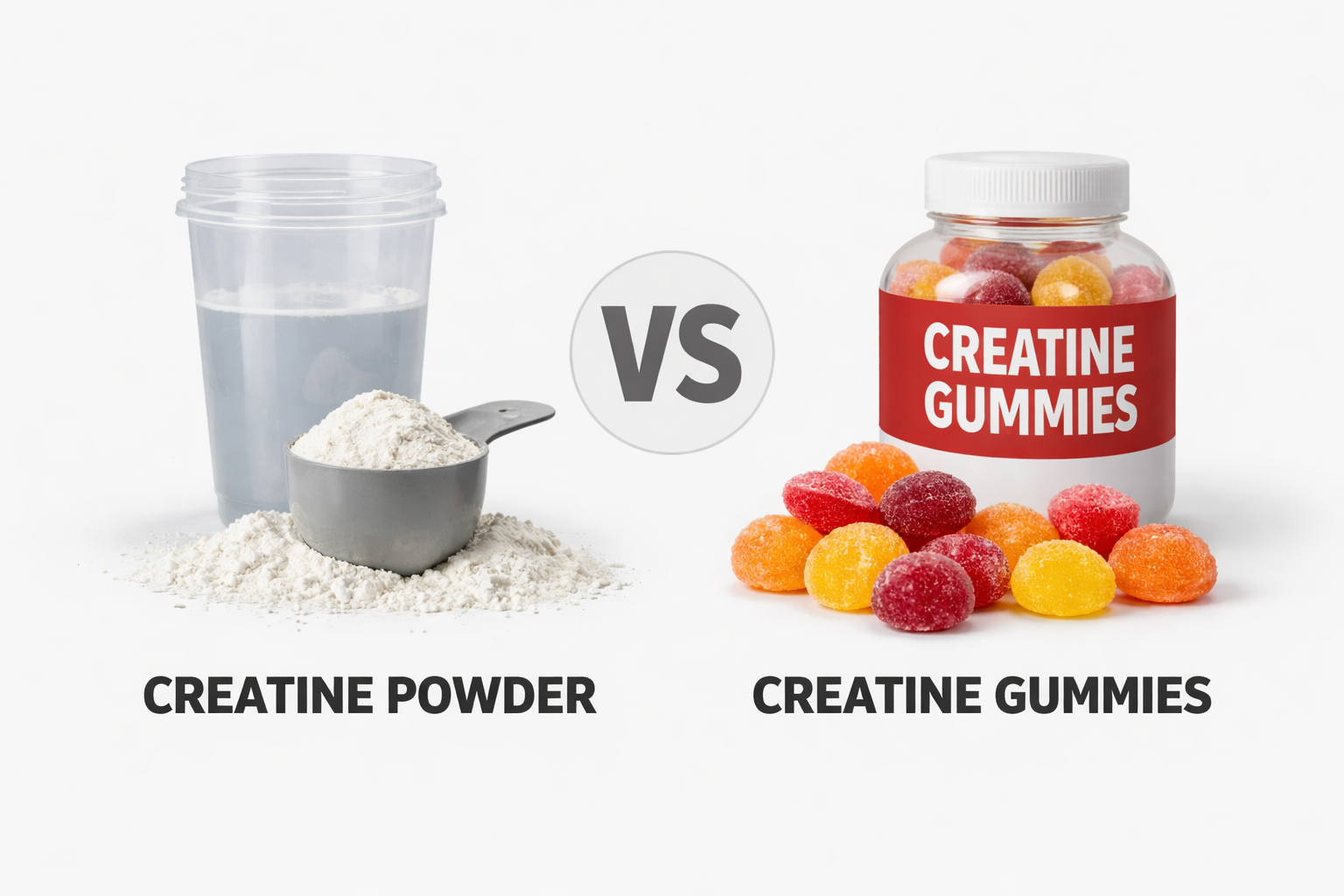
If you want to increase strength, boost endurance, and accelerate muscle growth, creatine is non-negotiable. It is the most studied sports performance supplement in history. However, the supplement aisle has evolved, leading to a modern debate: creatine powder vs gummies.
For decades, plain creatine monohydrate powder was the undisputed king. Today, the convenience and taste of gummy supplements are challenging that throne. So, which should you choose?
The Short Answer: If we are looking strictly at cost-effectiveness, purity, and the ease of a loading phase, creatine powder remains the undeniable champion. It is significantly cheaper, contains zero added sugars, and allows for precise dosing. However, if you struggle with the chalky texture of powders, frequently travel, or consistently forget to take your supplements, the convenience and taste-driven creatine gummies benefits make them a highly effective alternative that ensures you actually stick to your daily dose. Both deliver the same active ingredient to your muscles.
Let’s dive into a comprehensive comparison of absorption, bioavailability, cost, and effectiveness to help you determine the best creatine supplement for your specific lifestyle.
How Creatine Works in the Body
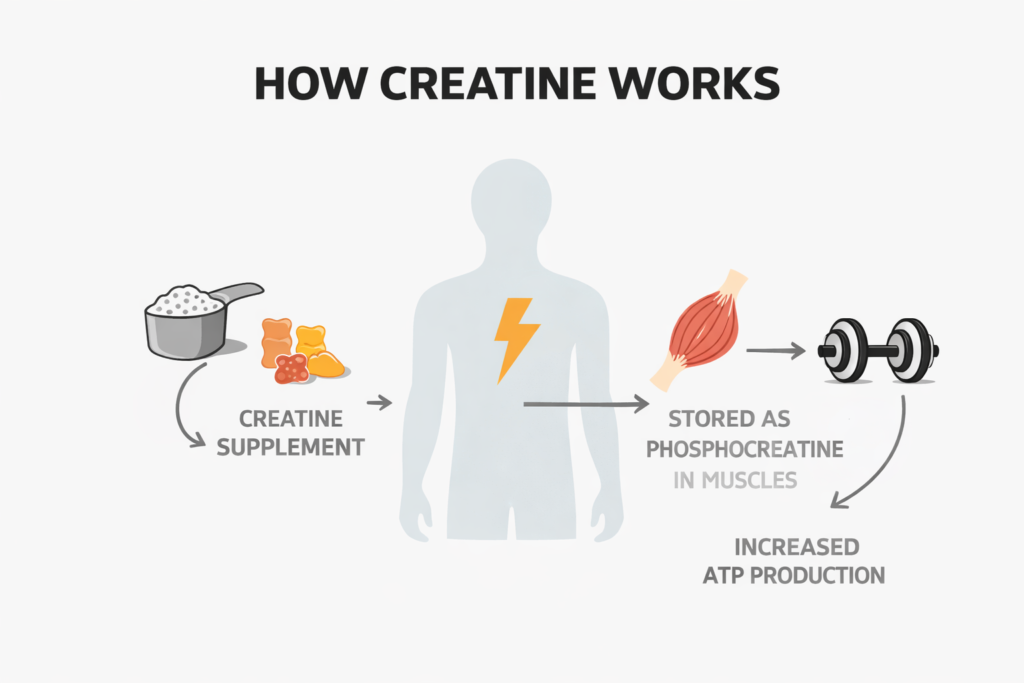
Before comparing delivery methods, it is vital to understand what creatine actually does. You cannot evaluate creatine powder effectiveness without understanding the biological mechanism behind it.
ATP Production and Energy
Your body uses Adenosine Triphosphate (ATP) as its primary energy currency. During high-intensity exercise, like heavy weightlifting or sprinting, your muscles deplete ATP within seconds.
Creatine is stored in your muscles as phosphocreatine. It steps in to rapidly regenerate ATP, allowing you to push out that extra rep, run a little faster, and maintain peak power output for longer. The International Society of Sports Nutrition (ISSN) officially recognizes creatine monohydrate as the most effective ergogenic nutritional supplement currently available to athletes.
The Bioavailability Factor
Bioavailability refers to how much of a substance actually enters your systemic circulation to have an active effect. Creatine monohydrate has a nearly 100% bioavailability profile. Your body absorbs it exceptionally well. The debate between powder and gummies essentially boils down to how the delivery system impacts this absorption and your daily adherence to taking it.
Creatine Powder: Benefits & Drawbacks
Traditional creatine powder—specifically pure creatine monohydrate—is the gold standard. Every major clinical trial demonstrating creatine’s benefits over the last thirty years utilized the powder form.
Unmatched Creatine Powder Effectiveness
Because powder is purely the active ingredient, there is no barrier to digestion. Once mixed with water and consumed, it rapidly empties from the stomach and is absorbed by the intestines. You are getting pure, unadulterated creatine, which maximizes creatine powder effectiveness.
Unbeatable Cost and Value
When it comes to the price tag, powder is in a league of its own. Because manufacturing is straightforward and requires no complex binding agents or flavoring systems (if buying unflavored), the cost per serving is incredibly low. A standard 5-gram serving of powder typically costs between $0.15 and $0.35.
Drawbacks: Mixability and Digestion
The main complaints regarding powder are purely functional. Unflavored creatine can have a slightly bitter, chalky taste. Furthermore, creatine monohydrate does not dissolve perfectly in cold water. You often end up with a gritty residue at the bottom of your shaker cup. For a small percentage of users, consuming this concentrated grit on an empty stomach can cause mild gastrointestinal distress.
Creatine Gummies: Benefits & Drawbacks
The supplement industry has seen a massive shift toward alternative delivery methods. Gummy supplements have skyrocketed in popularity for vitamins, and creatine is the latest addition to this trend.
Exploring Creatine Gummies Benefits
The primary advantage of gummies is behavioral, not chemical. The most effective supplement routine is the one you actually follow. Gummies are incredibly convenient. They require no water, no shaker bottle, and no measuring scoops. You can keep a bottle in your car, your desk, or your gym bag.
Furthermore, they taste like candy. For individuals who gag at the texture of powdered supplements, gummies transform a chore into a daily treat.
The Digestion Process
Interestingly, digestion of gummies begins in the mouth. Salivary enzymes start breaking down the gummy matrix before it even hits your stomach. Once in the digestive tract, the gelatin or pectin base dissolves, releasing the creatine. Assuming the gummy contains high-quality creatine monohydrate, the end destination (your muscles) remains exactly the same.
Drawbacks: Sugars, Fillers, and Price
To make a gummy taste good and hold its shape, manufacturers must use pectin or gelatin, natural or artificial flavors, and sweeteners. Many gummies contain 2 to 5 grams of sugar per serving. While not a massive amount, it is a consideration for those strictly tracking macros.
The most significant drawback is the price. The manufacturing process for gummies is complex. You are paying for convenience, with costs often ranging from $1.00 to $2.00 per serving.
Side-by-Side Comparison: Creatine Powder vs Gummies
To truly determine the best creatine supplement for you, we must look at how these two stack up across the most important consumer metrics.
1. Absorption Rates & Bioavailability
There is a common misconception that gummies absorb slower and are therefore less effective. The reality is that creatine is not a stimulant like caffeine. You do not need an immediate “hit.”
Creatine works via saturation. Your goal is to fill your muscle stores over time. Whether it takes 30 minutes to digest a powder or 45 minutes to break down a gummy is biochemically irrelevant to your muscle growth. Both forms offer near-perfect bioavailability once broken down in the gut.
- Winner: Tie. Both effectively saturate muscle stores.
2. Loading Phases and Dosage Precision
Many athletes utilize a “loading phase” when starting creatine—taking 20 grams per day for 5-7 days to saturate muscles quickly.
- Powder: Easy. You take four 5-gram scoops throughout the day.
- Gummies: Difficult. Most gummies contain 1 to 1.5 grams of creatine per piece. To get 20 grams, you might have to eat 15 to 20 gummies a day. This introduces a massive influx of sugar and fillers that will likely cause severe stomach cramping.
- Winner: Creatine Powder.
3. Stability and Degradation
When looking at creatine powder vs liquid supplements, liquid creatine is notoriously unstable and degrades into creatinine (a useless byproduct) very quickly. Gummies, however, are stable. Because the water activity inside a professionally manufactured gummy is tightly controlled, the creatine remains stable on the shelf just like dry powder.
- Winner: Tie. Both have excellent shelf lives.
4. Cost per Serving
If you are taking creatine daily (as recommended), cost matters.
- Powder: A 3-month supply might cost $30.
- Gummies: A 3-month supply could easily exceed $120.
- Winner: Creatine Powder.
5. Convenience and Portability
Carrying a tub of white powder through airport security or leaving it on your office desk can raise eyebrows. It also requires a liquid source to mix. Gummies can be eaten dry, anywhere, at any time.
- Winner: Creatine Gummies.
Is Creatine Powder or Gummies Better for Muscle Growth?
This is the most common long-tail question fitness enthusiasts ask. The answer relies entirely on the active ingredient.
If a powder and a gummy both deliver 5 grams of pure creatine monohydrate to your system daily, the muscle growth results will be identical. The mechanism of cellular hydration, ATP synthesis, and satellite cell signaling does not change based on whether the vehicle was water or a fruit-flavored chew.
The deciding factor for muscle growth is consistency. If buying a tub of powder means it sits in your pantry because you hate the taste, its effectiveness is zero. If spending extra on gummies means you never miss a day, the gummies will yield superior muscle growth simply because of improved adherence.
Which Should You Choose? Scenarios for Success
There is no universal “better” option in the creatine powder vs gummies debate. It depends entirely on your friction points.
When to Choose Creatine Powder
- You are on a budget: Powder is unmatched in affordability for long-term daily use.
- You plan to do a loading phase: It is the only safe and practical way to consume 20g a day without consuming a mountain of sugar.
- You practice intermittent fasting: Pure, unflavored powder has zero calories and will not break a fast.
- You already drink a daily shake: Throwing a scoop of unflavored powder into your post-workout protein shake or pre-workout adds zero extra steps to your routine.
When to Choose Creatine Gummies
- You hate drinking powders: If grit, chalky textures, or artificial powder flavors turn your stomach, gummies bypass this entirely.
- You travel frequently: A bottle of gummies in a carry-on is hassle-free and requires no mixing setup in a hotel room.
- You struggle with supplement consistency: If you constantly forget to take your creatine, a tasty gummy on your desk acts as an excellent, frictionless reminder.
- You have a sensitive stomach: For some, eating a gummy with other food elements prevents the mild nausea associated with drinking powdered creatine on an empty stomach.
The Final Verdict
When evaluating creatine powder vs gummies, the science is clear: the vehicle matters far less than the active ingredient inside it. Both forms will fully saturate your muscles, boost your ATP stores, and aid in muscle recovery and growth.
Powder is the purist’s choice—it is cheap, effective, and free of unnecessary additives. Gummies represent the ultimate in user experience—they are convenient, delicious, and heavily encourage daily consistency.
Next Steps: Take a look at your daily routine. Do you prioritize maximum cost-efficiency and purity, or are you willing to pay a premium for taste and on-the-go convenience? Choose the format that seamlessly fits into your lifestyle, ensure it contains high-quality creatine monohydrate, and watch your gym performance soar.